AUCKLAND TRANSPORT | 2021
New to public transport
Encouraging new users to try Auckland’s public transport network.

01 / Overview
In 2021, In order to reach pre-pandemic patronage levels, Auckland Transport wanted to encourage more new users onto the transport network. The goal was to uncover and reduce problems and barriers for customers that were new to public transport. I worked alongside the core team through explore and design sprints to uncover insights and pain points for this customer segment and workshop, prototype and test potential solutions. As a result of this work, the organisation was able to better understand the problems and pain points that new to public transport customers face. We ideated and tested five viable solutions with customers and presented these to senior executives to be taken forward.
02 / Discovery / Research
To better understand the customer problem, the team interviewed eight customers who were new to public transport (PT). We distilled insights and quotes from these interviews into key themes. The project took place during a COVID-19 lockdown in New Zealand, so all interviews, workshops and testing sessions were conducted remotely using Microsoft Teams, Miro and Figma. After speaking with customers, we gathered key quotes, grouped insights into themes and identified common problems. We then created personas and mapped customer journeys in workshops to identify the stages that caused difficulties for new customers.

Our process
The project included discovery, exploration and design phases. Discovery and exploration gave us the foundation to move quickly into design and prototyping.
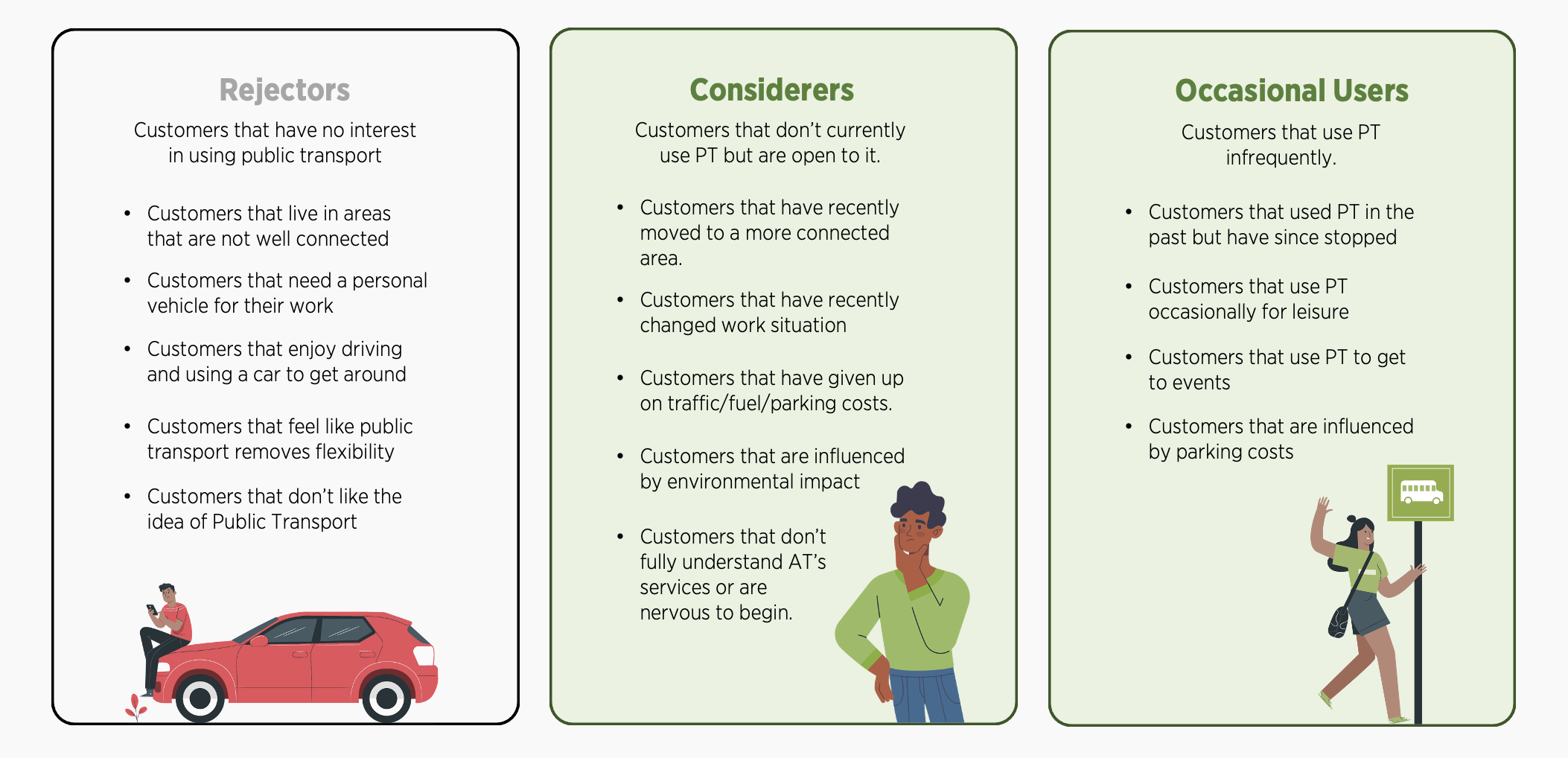
Our understanding of the segmentation of new users.
Through discovery, we identified three distinct groups based on their attitudes towards adopting public transport. We excluded “rejectors” from concept ideation and focused on “considerers” and “occasional users”. This helped us define the needs we wanted to address more precisely.
03 / Design / Ideation
Using the insights and problem statements from our exploration phase, we held ideation sessions with subject matter experts and the core team to generate and prioritise ideas that could address the problems customers faced when trying public transport for the first time. During these sessions, I was responsible for wireframing, rapid storyboarding and prototyping concepts using Figma and Illustrator. I presented these concepts back to the team during or shortly after the workshops so we could iterate and refine them quickly.
04 / Prototyping / Testing
We then prioritised and further developed the five most popular concepts. I prepared these for usability testing using Figma prototyping and stitched the concepts together into one cohesive test with main menu (index). We tested the five concepts with eight customers via Microsoft Teams video calls. I was able to refine the prototypes between interviews in order to continously improve and iterate the concepts. This included things like pricing changes and customer facing language used.

The prototype index page with entry points for the 5 concepts that we tested.

Concept example: $2 Summer
$2 Summer
We tested this concept to address fare and zone confusion and encourage new customers to try public transport over summer. Promotions would direct customers to a checklist to help them prepare for their first journey.

Concept example: Refer a friend
Refer a friend
Discovery revealed hesitation among people considering public transport. Customers were anxious about how to use the service, network reliability, and etiquette at stations and on board. We tested a referral concept that rewards both parties, encouraging existing users to support their friends’ early journeys.
05 / The Outcome
After testing, the concepts and findings were presented back to senior stakeholders and executives and proved useful in framing the strategies taken forward for encouraging new customers to try public transport. Rapidly prototyping, testing and iterating enabled us to move quickly, identify successful concepts and rule out any that were not desirable.